Ecological Dynamics
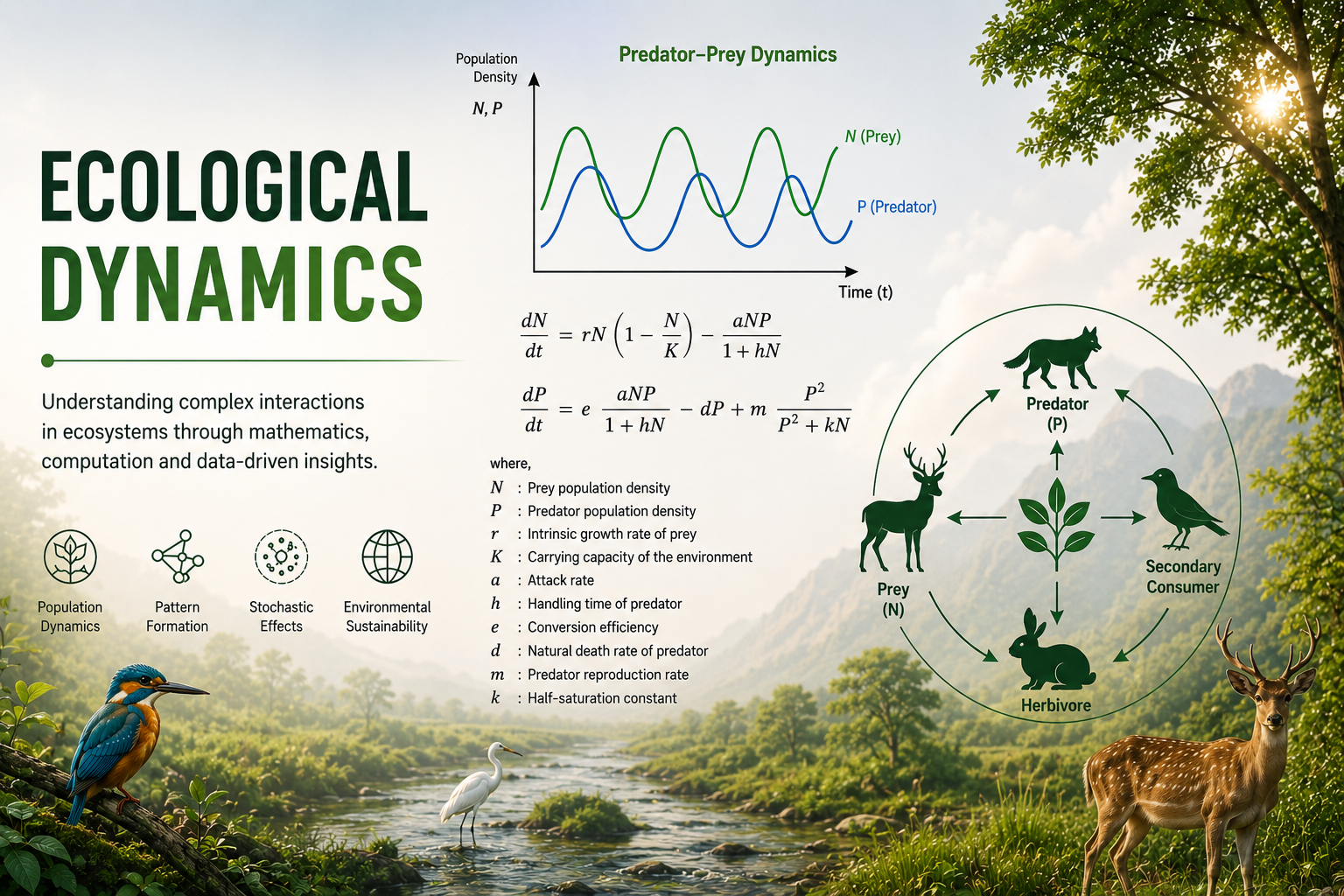
Ecological dynamics investigates the complex interactions among species, their environments, and external perturbations through mathematical and computational approaches. This research focuses on nonlinear ecological systems involving predator-prey interactions, pattern formation, stochastic effects, Allee dynamics, nonlocal interactions, and ecosystem resilience. These studies aim to understand how spatial heterogeneity, diffusion, environmental fluctuations, and behavioral responses shape ecological stability and biodiversity.
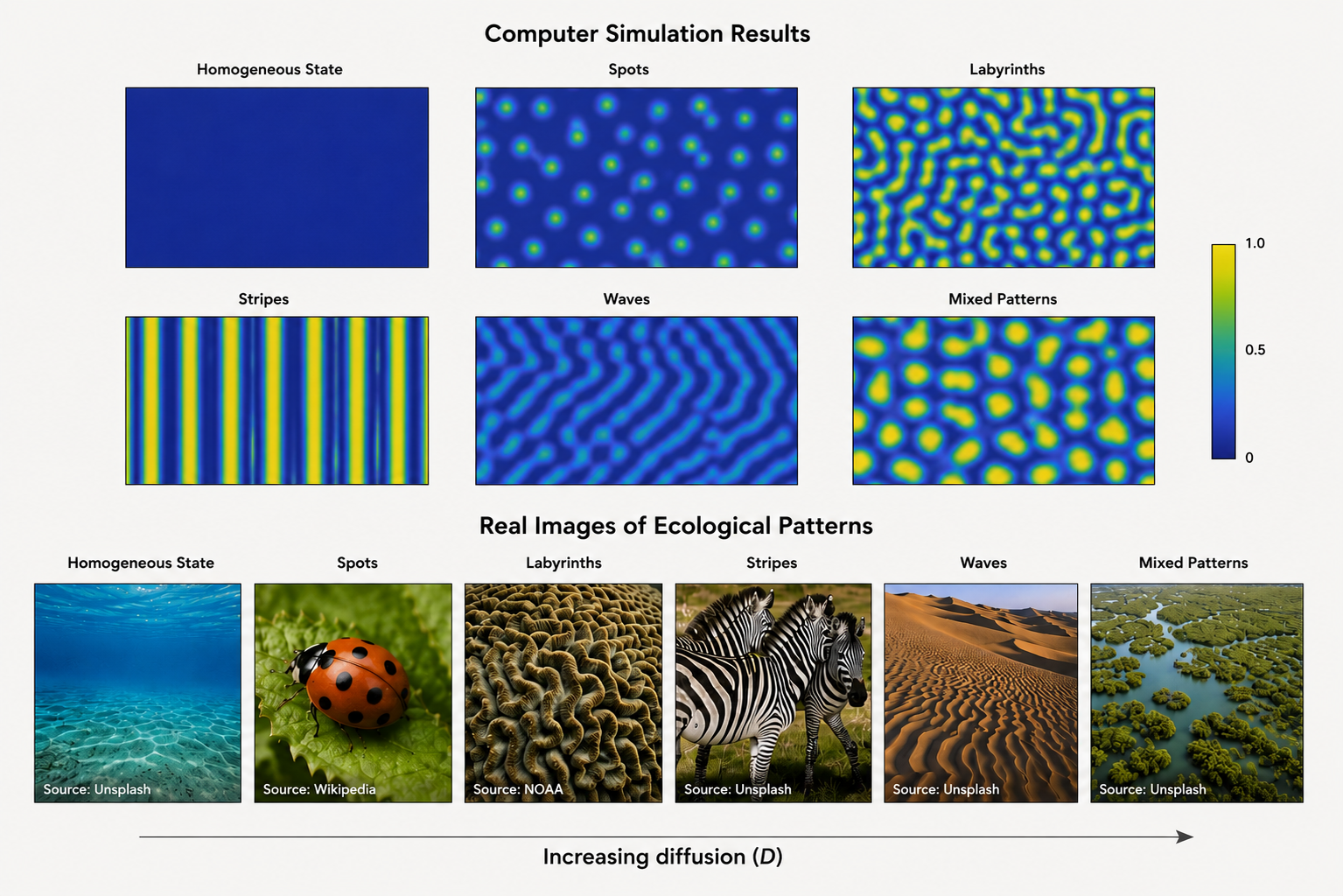
A significant part of this research addresses spatio-temporal ecological models, where reaction-diffusion systems are used to investigate pattern formation, wave propagation, and bifurcation behavior. Special emphasis is placed on understanding Turing instability, self-organization, and nonequilibrium ecological transitions. The research also explores semiarid ecosystems, ecological sustainability, and adaptive defensive mechanisms in prey populations.
Research Methodology
- Reaction-diffusion modelling of predator-prey systems
- Linear stability and bifurcation analysis
- Turing instability and pattern formation analysis
- Nonlocal interaction kernels and spatial ecology
- Numerical simulations using finite difference methods
- Machine learning-assisted ecological prediction
Research Themes
- Predator-prey dynamics with diffusion and taxis
- Noise-induced ecological transitions
- Nonlocal ecological interactions
- Semiarid ecosystem sustainability
- Ecological resilience under environmental stress
- Adaptive defense mechanisms in prey populations
- Spatial pattern formation and self-organization
Representative Contributions
The study of nonlocal prey-predator interactions demonstrated how spatial kernels modify ecological patterns and stability properties. Research on stochastic ecological systems revealed that demographic noise can induce oscillations and complex spatio-temporal behavior, even in systems that do not exhibit deterministic pattern formation. Recent studies also investigate ecological sustainability in semiarid regions, highlighting the role of soil surface interactions and environmental variability.